−
Relentlessly mitigate eCosts.
Reducing eCosts is generally more powerful than adding equivalent eGains — and it should be the first place any designer looks.
RemoveAutomateSimplifyDelayReframe
Emotional ROI · Robin Krieglstein
An Emotional ROI guide to designing for real human behavior.
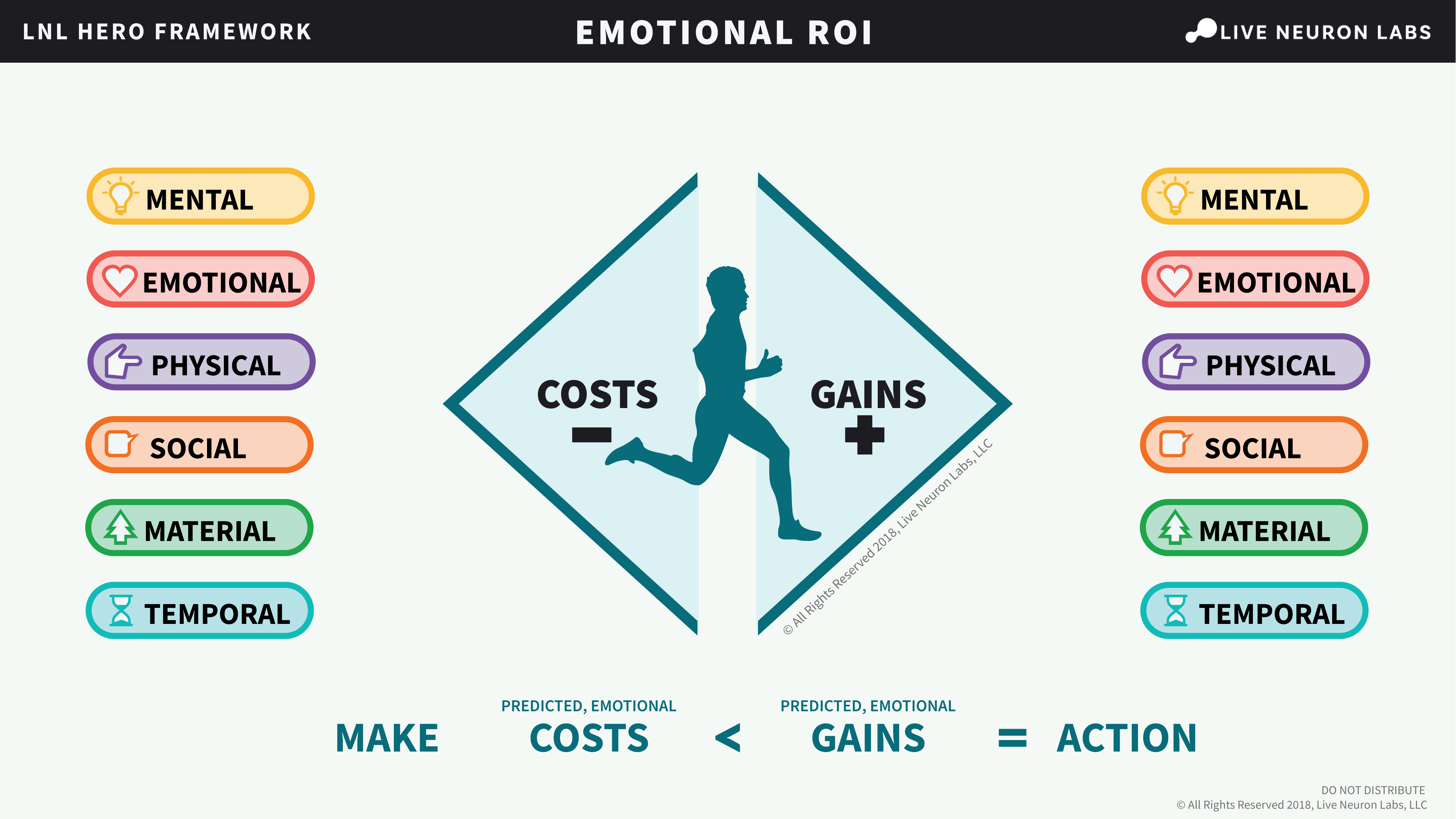
Before any person takes any action, their brain rapidly estimates the emotional costs and emotional gains of that action. If the gains look like they’ll win, they act. If the costs look like they’ll win, they don’t.
The knowing-doing gap
Humans don’t behave according to what we know. We behave according to deeper, invisible systems that evolution wired into us long before modern life existed.
That gap — between knowing and doing — is the doorway into the real story.
Try the model
It’s perceived, not real. The brain evaluates predicted costs and gains, filtered through memory, emotion, and bias.
Effort, discomfort, risk, things I might lose, things that feel bad.
Pleasure, relief, connection, things I might gain, things that feel good.
A 2-point difference
The brain isn’t doing a rational spreadsheet analysis. It’s doing a fast, fuzzy emotional scan.
Go one level deeper
The simple equation is only the beginning.
The brain isn’t evaluating actual costs and gains — it’s evaluating predicted costs and gains, based on incomplete information, filtered through memory, emotion, and bias. This matters enormously, because it means the opportunity to change behavior often isn’t about changing the real cost structure at all. It’s about changing the perceived cost structure at the moment of decision.
Consider two people who each have to spend a thousand dollars on a repair. One of them barely registers it; the other feels genuine anxiety for days. Same dollar amount, wildly different emotional cost. The emotional experience of a cost is not the same as its objective size.
The brain isn’t doing a rational spreadsheet analysis. It’s doing a fast, fuzzy emotional scan. Things that feel costly matter — regardless of whether they’re logically costly.
A long registration form doesn’t cost you much objectively, but it feels effortful and off-putting, and that feeling is often enough to stop someone cold.
The eROI calculation isn’t made once and remembered. It’s re-evaluated constantly, at every step of an experience. Every screen, every sentence, every interaction is recalculating.
Dip below a certain eROI threshold at any moment and engagement collapses — sometimes instantly.
Your brain isn’t a CEO making calm rational decisions. It’s more like a government — many different regions and systems each casting votes, with competing interests, biases, and emotional weights.
What’s salient in a given moment gets more weight. What’s in front of you matters more than what’s abstract. Immediate costs and gains matter far more than future ones.
One of the most robust findings in behavioral economics is that losses hurt roughly twice as much as equivalent gains feel good. This means that eCosts carry more weight than eGains of the same size, all else being equal.
Reducing eCosts is generally more powerful than adding equivalent eGains — and it should be the first place any designer looks.
Six dimensions of experience
Most behavior-change efforts operate in only one or two dimensions of the eROI equation while ignoring the rest.
 InternalConscious, effortful prefrontal cortex work
Memorizing, decision-making, complexity, figuring things out, uncertainty
Clarity, insight, AHA moments, wordplay, discovery, puzzles, progress
 InternalAutomatic emotional responses triggered by cues
Shame triggers, fear imagery, negative faces, dark aesthetics, negative language
Beauty, warmth, hope, humor, cuteness, positive imagery, positive faces
 InternalSenses (input) and motor function (output)
Sensory difficulty, extra clicks, physical effort, pain, awkward interactions
Pleasing sensory experiences, satisfying physical actions, movement, laughter
 ExternalOther people (and things with social properties)
Embarrassment, exclusion, social exposure, defying norms
Belonging, significance, acknowledgment, empathy, recognition, connection
 ExternalTangible and digital resources
Losing money, time, points, progress, access, possessions
Gaining money, rewards, points, badges, access, convenience, privilege
 ExternalTiming of costs and gains
Delayed payoff, long time costs, uncertainty about timing
Immediate rewards, time savings, lasting benefits, compressed timelines
The dimensions can overlap. The value is in making sure you’re looking at all six, not sorting every experience into exactly one box.
The dimension library
Each layer moves from the big idea to specific eCosts and eGains you can recognize in a real experience.
Internal dimensionMental: The conscious, effortful work of the thinking brain
The Mental Dimension refers specifically to the conscious, effortful work your brain does in the prefrontal cortex — the region that developed relatively late in our evolutionary history. You may have heard it called “System 2,” “the thinking brain,” or “executive functions.” Whatever the label, it’s the part of you that deliberates, calculates, decides, focuses, memorizes, recalls, and figures things out.
This is slow, expensive work. Ounce for ounce, the prefrontal cortex is the most metabolically costly region of the entire body. Your brain knows this, and it guards that resource jealously.
Every extra bit of mental effort you ask of someone is an eCost. Each one is likely dropping some percentage of your audience at that moment.
Mental eCosts are any consciously effortful activities you’re asking someone to perform. Think of cognitive load like a budget that depletes.
Asking someone to commit something to memory for later use — a password, an instruction, a series of steps — is a real cost. Design to prevent it: provide information just-in-time, build in reminders, and don’t assume that because you told someone something, they’ll remember it.
Even harder than memorizing is expecting someone to remember something they learned earlier — especially when some time has passed, or the current situation feels different from the learning situation. Design to trigger that recall, or better yet, don’t require it at all.
Every decision is a mental cost. Every additional option on a menu, every question without a clear recommended answer, every choice you ask someone to make — all of it draws down the mental budget. Be prescriptive.
The more options you provide, the more comparison work you require. Reduce options aggressively. Indicate the best choice clearly. If there are truly many options, provide a prominent “best pick” and a less prominent “more options” link for the edge cases.
Long sentences, long paragraphs, long documents — all of it costs effort. Ruthlessly cut extra words. Keep paragraphs to two or three sentences. Front-load the most important information.
Too often, experiences leave people to figure out on their own what’s happening, what it means, and what they should do next. That ambiguity is a cost. Find every place someone gets confused. Then make it crystal clear.
Unfamiliar vocabulary is a tax on comprehension. Even words someone technically knows but rarely uses add friction. Write below your audience’s average reading level — not because they’re not smart, but because reading below your reading level is physically easier and more comfortable.
When things are uncertain or unpredictable, that uncertainty is a cost. Give people a clear picture of what to expect, what’s being asked, what the outcome will be, and why they should trust the process.
Attention is a finite resource. Long sessions requiring sustained concentration deplete it. Design to minimize competition for attention and to break longer tasks into manageable, clearly bounded pieces.
Mental eGains make the brain feel like it’s working well — moments of insight, discovery, learning, and cognitive success.
The sudden sensation of understanding something — “oh, now I get it” — is genuinely rewarding. Make concepts click. Use metaphors, analogies, and concrete examples to make the abstract tangible.
Wordplay, puns, rhymes, clever double meanings, and a well-constructed joke work partly through the cognitive pleasure of getting it. The brain performs a tiny, satisfying act of pattern recognition.
The brain is wired to pay attention to new information. Novel ideas, unexpected twists, and genuine surprises all capture mental engagement.
The brain likes to win. Challenges that are difficult enough to feel like an achievement, but not so difficult they feel impossible, are deeply engaging.
The feeling of improving, of getting better at something, of making visible progress toward a goal — all of these are mental rewards. Progress bars, skill unlocks, and visible metrics signal that the brain’s effortful work is paying off.
Well-organized information — clear hierarchies, numbered lists when appropriate, consistent visual patterns — reduces cognitive load while making content easier to process.
Internal dimensionEmotional: Automatic emotional responses triggered by environmental cues
While the Mental Dimension covers the conscious, deliberate work of the prefrontal cortex, the Emotional Dimension covers something different: the automatic, nonconscious emotional responses that get triggered by cues in the environment.
Emotions range from the obvious — fear, joy, grief, excitement — to the subtle: vague unease, mild warmth, a faint sense of belonging. Many of them happen below the threshold of conscious awareness.
These responses are fast, powerful, and deeply influential on behavior. And they’re triggered not just by obviously emotional content, but by visual design, language choices, colors, faces, imagery, tone of voice, and the feel of a physical space.
Emotional eCosts are cues, associations, and experiences that trigger negative emotional states — often causing people to disengage or avoid.
Anything that makes someone feel stupid, incompetent, wrong, or exposed creates shame — one of the most aversive emotional states humans experience. Red error messages, harsh feedback, public failure, and forms that highlight mistakes can terminate engagement instantly and permanently.
Images or concepts associated with danger, threat, or bad outcomes. This extends beyond the obvious to alarming language, uncertain outcomes, high-stakes decisions, and anything associated with loss or failure.
Disgust is an ancient protective response, originally associated with contaminated food or disease. But it generalizes: ugly design, chaotic visual environments, and anything that feels “off” or wrong can trigger mild disgust responses.
Faces expressing fear, anger, or sadness are processed rapidly by the brain and trigger corresponding emotional states in the viewer. A sad face in a health app, even if used to communicate empathy, can inadvertently create a negative emotional state.
Color psychology isn’t absolute, but associations are real. Dark palettes, harsh contrasts, and heavy visual environments often trigger more vigilant, negative emotional states than light, airy, warm ones.
The emotional valence of words matters independently of their literal meaning. “You haven’t completed your profile yet” hits differently than “Add a few more details to get started.”
Emotional eGains are cues, associations, and experiences that trigger positive emotional states — increasing eROI and driving engagement forward.
Genuinely well-designed visual environments feel good. Harmonious colors, elegant compositions, beautiful photography, and pleasing symmetry create mild but consistent positive emotional states. Beauty isn’t decoration; it’s a real eGain.
Language, imagery, and tone that communicate genuine care, optimism, and possibility are powerful emotional eGains. Anything that credibly signals “this is going to get better” is doing important work.
Cute works. Cute animal features trigger a nurturing response in humans that floods the system with positive affect. Deployed appropriately, cute illustrations, characters, and animals are not frivolous. They’re legitimate eGains.
The warm emotional experience of finding something funny is a strong positive emotional state. A single well-placed witty line can shift the entire emotional tone of an experience.
Just as negative faces trigger negative emotional states, smiling, laughing, warm faces trigger positive ones. If you want people to feel good, show them people who feel good.
Sound has direct pathways to the emotional centers of the brain. Music can shift emotional state quickly and profoundly. The right sonic environment isn’t a nice extra — it’s an emotional design decision.
Sunsets, nature, puppies, laughter, and children at play work because they trigger the warm, safe, positive emotional states we associate with them.
Internal dimensionPhysical: The body’s sensory inputs and motor-function outputs
The Physical Dimension refers to everything outside the nervous system — specifically, the body’s input and output systems. Think of it in two parts: your inputs, the senses through which you perceive the environment, and your outputs, the motor functions through which you act on it.
Physical eCosts are everywhere in digital experiences: small fonts, low contrast, cluttered interfaces, too many clicks, and forms that require awkward navigation. Physical eGains — sound design, animation, satisfying tactile feedback, the physical act of swiping or tapping when it feels just right — can be the difference between an experience that feels good and one that feels effortful.
Ask how effortful, uncomfortable, or difficult it is to perceive what’s needed or perform what’s required.
Any situation where perceiving the necessary information is physically difficult counts as a physical eCost: text that’s too small or low-contrast, audio that’s too quiet or noisy, too much competing visual information, or fonts that are beautiful but hard to read. If a larger font is necessary for a senior to read, it’s easier for everyone else too.
Any physical action required to engage carries a cost. Extra clicks, complex gestures, physical travel, filling out lengthy forms, lifting, carrying, and typing are all physical eCosts. The more an action requires precision, speed, strength, balance, endurance, or fine dexterity, the greater the cost.
Be especially attentive to the variance in physical capability across your audience. An action that feels effortless to a healthy 25-year-old may be genuinely difficult for a 60-year-old or someone with a physical limitation.
Physical actions performed repeatedly over time tend to become less costly as they become habitual. Muscle memory reduces the conscious effort of actions we’ve done many times.
Physical eGains are sensory experiences and physical activities that feel genuinely good — and they’re more available than most designers realize.
Beautiful, harmonious visuals. Pleasing audio. Satisfying tactile feedback. The right scent in a physical space. These are genuine physical eGains across almost every kind of designed experience.
Rhythmic or cardiovascular movement, stretching, dance, yoga, and mindful breathing produce strong physical eGains. The physical eGains of a target behavior can be amplified and highlighted as part of the pitch for participation.
Reclining after effort, warmth, being groomed, massage, deep breaths, and the sensory relief of putting down a heavy bag are physical eGains that can be referenced, offered, or designed for.
Certain physically challenging or mildly painful experiences trigger endorphin responses afterward that feel genuinely good. Help people get past the initial physical eCost and into the payoff on the other side.
Laughter is a physical experience. The breath, body movement, and neurochemical cascade are a genuine physical eGain, quite separate from the intellectual pleasure of getting a joke.
External dimensionSocial: Belonging, significance, and the influence of other people
The human superpower is our ability to collaborate with other humans at a scale and sophistication no other species approaches.
Our brains evolved to make this collaboration possible — which means our brains are deeply, urgently wired for social connection. We crave belonging. We’re exquisitely sensitive to social signals. We process social pain through the same neural pathways as physical pain.
The social dimension extends beyond actual human interaction. Inanimate things — software, media, even objects — can trigger social responses when they’re experienced as having social properties. The social brain doesn’t always check IDs.
The two core social drives are belonging — being part of the group — and significance — mattering within the group. Social eCosts threaten either one.
Publicly displaying someone’s failure, mistakes, or shortcomings is one of the most powerful eCosts in any designed experience. Leaderboards that show who’s at the bottom and public accountability systems that shame rather than support can catastrophically backfire.
Anything that makes someone feel foolish, incompetent, or out of place in front of others. This can be direct or as subtle as language that assumes a level of sophistication the user doesn’t have.
Being left out — of a group, a conversation, an activity, a community — activates real pain. The flip side is that inclusion is one of the strongest eGains available.
Being asked to do something that puts us at odds with our peer group creates social eCosts that can override everything else. This is why behaviors that make someone “the weird one” are so hard to sustain.
Disparagement, rudeness, shunning, downvoting, and unfollowing all activate social pain responses. Even mild versions delivered through digital interfaces carry real eCosts.
We can experience social eCosts vicariously. Being aware that others are suffering, excluded, or humiliated creates its own discomfort.
The richest social eGains help people feel that they are in the group and that they matter within it.
Using someone’s name, remembering them, and acknowledging their history are small but powerful signals of connection. Empathetic language, shared rituals, shared challenges, shared wins, invitations, and affirmation all feed the belonging drive.
Being given a title, position, or award. Public acknowledgment of accomplishment. Being asked for advice. Acknowledgment of distinctive characteristics. These tell someone that their perspective and presence matter.
Knowing that many people we respect have done something makes it easier to do it ourselves. Testimonials and endorsements tap into social eGains while reducing the risk of being “the weird one.”
External dimensionMaterial: Resources that can be owned, spent, accumulated, earned, or lost
The Material Dimension covers the tangible resources of the world — everything that can be owned, held, spent, accumulated, earned, or lost. Money is the most obvious example, but material value includes physical objects, collectibles, access and privileges, and in digital contexts: points, badges, levels, virtual goods, followers, and metrics.
This is probably the dimension most familiar to traditional behavior designers — the realm of incentives, rewards programs, and gamification. And it works. Material incentives drive behavior. But they are often overused as a first resort when they should be a last one.
Loss aversion is especially vivid in the material dimension. We are roughly twice as motivated to avoid losing something as to gain something of equivalent value.
The most obvious material eCost. Anything that requires spending money — fees, subscriptions, purchases — faces the full weight of loss aversion.
While time has its own dimension, the feeling that you’re “spending” time like a finite resource has material qualities.
Losing objects, progress, data, or any accumulated physical thing creates a material eCost.
Points, levels, badges, streaks, virtual goods, and followers become real material assets to the brains that acquire them. Features that protect or bank people’s progress directly reduce a material eCost.
The sense that choosing one thing means giving up another is a real material cost, even when nothing tangible is being given up.
Material eGains work best when they feel meaningful and directly connected to the target behavior.
Financial rewards are motivating, but they work best when directly connected to the target behavior. Applied carelessly, they can undermine intrinsic motivation.
Points that feel arbitrary and disconnected from meaningful progress aren’t genuinely rewarding. Points that signify real achievement within a system people care about can be enormously motivating.
Exclusive content, early access, elevated status, and special features are material eGains that also have significant social dimensions.
Saving someone time, eliminating a step, and making something easier are material eGains. Convenience is underrated as a motivator.
Scarcity, competition, and association all amplify material eGains. The same object has different value depending on its history and meaning.
External dimensionTemporal: The timing of costs and gains — not just their presence
Time is a resource that can be spent or saved, and it overlaps with every other dimension. But it deserves its own category, because the timing of costs and gains — not just their presence — has a profound effect on behavior.
The central insight is simple and powerful: immediate eGains are valued far more than delayed eGains of the same size. The gains of most target behaviors arrive far in the future. The costs arrive right now. Under this structure, System 1’s perpetual “now” focus will almost always favor the easier, more immediately rewarding option.
Temporal eCosts grow when actions consume more time, rewards move farther away, or the timeline becomes uncertain.
Every behavior takes time. Time spent preparing, executing, and recovering from an action is a temporal eCost. The longer the time cost, the higher the eCost — unless the activity itself provides other eGains that compensate.
When the reward won’t arrive for weeks, months, or years, its perceived value drops dramatically. “You’ll feel better tomorrow morning” is a stronger motivator than “you’ll be healthier in twenty years.”
Not just delay, but uncertainty about timing increases temporal eCost. “You’ll feel better eventually” is worse than “you’ll feel better in about two weeks.” Give people a clear, honest timeline.
Deadlines, countdowns, and urgency signals make the situation feel more demanding. They can activate action, but they are still eCosts and should be used ethically.
Temporal eGains make rewards feel present, return time to people, or keep a benefit working longer.
Instead of one large reward at the end of a long behavior chain, distribute small, immediate positive signals throughout the experience. Each one reinforces the last. Each one makes the next step feel worth taking.
Getting time back — through tools, shortcuts, automation, and streamlined processes — is a genuine and powerful eGain.
The longer a positive experience lasts, the more valuable it is. Designing so that a good outcome persists over time amplifies its perceived value.
You can’t always deliver an immediate final payoff for a long-term behavior. But you can create proximal payoffs — things that feel rewarding right now and are meaningfully connected to the larger goal.
Two keys to more action
Reducing eCosts is generally more powerful than adding equivalent eGains — and it should be the first place any designer looks.
Create a steady flow of small, varied eGains throughout the experience, so every step offers something rewarding.
The behavior design method
The framework is analytical and practical. Here’s how to use it on a real project.
Start by mapping out every action your hero must take — internal and external — to achieve the target behavior. Don’t just map the obvious external steps. Go granular.
At every stage: what does the person have to think, feel, physically do, navigate socially, spend, and find time for? Map it all.
With the journey mapped, go through each step and each of the six dimensions and identify every eCost present. Be thorough — most first-pass analyses dramatically undercount the eCosts people face.
What must they figure out? What might make them feel bad? What physical effort is required? What social risk is present? What might they lose? How long does this take, and when does the payoff arrive?
For each eCost you’ve identified, ask: how can I reduce, eliminate, delay, or simplify this?
Be ruthless. Every unnecessary cost you remove is a permanent improvement to eROI.
Can this step, decision, or requirement be eliminated entirely?
Can this be done for the person, rather than by them? Pre-filled forms, default choices, and auto-scheduling remove the need for the person to act.
Make the step smaller, clearer, or easier. Break complex steps into micro-steps. Replace decisions with recommendations. Replace jargon with plain language.
If an eCost can’t be removed, push it later in the journey, after the person is more committed and has more momentum.
Address fears directly, provide context for why something is necessary, or communicate what to expect to reduce the felt cost even when the actual cost remains.
With eCosts addressed, actively design eGains into the experience — and not just material ones. The most powerful eGains for sustained engagement are often emotional, social, and mental, and many cost almost nothing to deliver.
Create a steady flow of small, varied eGains throughout the entire experience, so that every step offers something rewarding, not just the final destination.
A message that says “We’re glad you’re here” takes two seconds to write and creates genuine emotional gain.
A simple bar showing how far someone has come makes mental progress visible and real.
Celebrate small achievements. Check marks, completion sounds, and a word of genuine encouragement trigger real reward responses.
A single funny sentence in a long form can shift the entire emotional valence of the experience.
Using someone’s name, remembering their history, and acknowledging their specific situation create social eGains out of proportion to the effort they require.
A surprising piece of information at the right moment makes the person feel like they learned something and makes the experience feel worth their time.
Genuinely thanking someone for their time, effort, or participation is a social eGain that signals their significance.
Worked examples
The behavior becomes more achievable when the designed eROI changes.
A morning walk seems simple until you run the experience through all six dimensions.
Deciding whether today is a walk day and figuring out a route.
Leaving comfort and feeling mild shame about inconsistency.
Getting dressed and performing the physical exertion.
Being seen exercising publicly.
Giving up contested morning time.
Waiting weeks or months for the health payoff.
Clarity and perspective from moving outside.
Natural light, greenery, and the satisfaction of doing it.
Endorphins after the initial effort.
A walking buddy and community accountability.
Visible accumulated progress.
Immediate mood and energy improvement.
Onboarding often front-loads nearly every eCost while delaying the useful thing the app actually does.
Too many fields, decisions, instructions, and jargon.
Cold design and punishing error messages.
Small tap targets and awkward password rules.
Social requests before trust exists.
A time commitment before value is clear.
A useful outcome hidden several screens away.
Make the next step crystal clear.
Lead with delight and a warm human voice.
Cut steps and auto-fill wherever possible.
Delay social requests until trust exists.
Celebrate every completed step.
Reach the first success moment immediately.
A distant health benefit cannot do all the motivational work by itself.
Complex recommended changes.
Embarrassment about admitting struggles.
The physical effort of new routines.
Feeling exposed or judged.
Losing familiar comforts.
Time spent tracking and checking in.
Provide immediate micro-wins.
Normalize struggle with empathetic language.
Amplify the intrinsic physical rewards.
Build belonging with others on the journey.
Celebrate every positive step.
Compress the timeline to reward.
The essential question
Find the hidden eCosts. Reduce them. Then build enough immediate, varied eGains into the journey that the better action becomes the emotionally easier choice.
Return to the beginning